
For decades, parents signed their kids up for piano lessons for two reasons: to make them smarter (the "Mozart Effect") or to teach them discipline. In recent years, the perception has evolved dramatically. In a world dominated by screens and superficial digital connections, parents are looking for something deeper.
They want their children to have empathy, resilience, and the ability to collaborate. That is why Social Emotional Learning (SEL) through music activities have seen a sharp rise among US parents. The new wave of music education isn't about raising a concert pianist; it’s about raising a well-adjusted human being.
What is SEL in Music?
Social Emotional Learning focuses on five core competencies: Self-awareness, Self-management, Social awareness, Relationship skills, and Responsible decision-making. Music is the perfect vehicle for this.
Empathy: This is the most significant benefit of music education for children. When a child plays in an ensemble, they have to listen to others. They learn that their part is important, but so is the person next to them. If they play too loud, they ruin the group's sound. It is a physical lesson in compromise and respect.
Resilience: Learning an instrument is hard. You fail constantly. You play a wrong note, you fix it, you try again. This builds "Grit", the ability to persist through frustration.
The ADHD Superpower
For neurodivergent children, specifically those with ADHD, music class can be a sanctuary.
The Science: Recent 2025 studies highlight "Auditory-Motor Integration." The act of keeping a beat synchronizes the brain.
The Benefit: Rhythmic training (drums, percussion) helps regulate the brain's internal clock. It improves Inhibition Control, the ability to stop and think before acting.
The Approach: Look for teachers in music schools with a holistic approach who specialize in "adaptive music lessons." They use movement and rhythm rather than sitting still and reading sheet music, turning the child's energy into a musical asset rather than a disruption.
Group vs. Private: The Social Choice
If your goal is social skills, Group Classes beat private lessons every time.
Toddlers (Kindermusik/Music Together): Group music classes for toddlers are not just "sing-alongs." They result in early socialization activities. Passing instruments, waiting for a turn, and moving together in a circle teaches non-verbal communication.
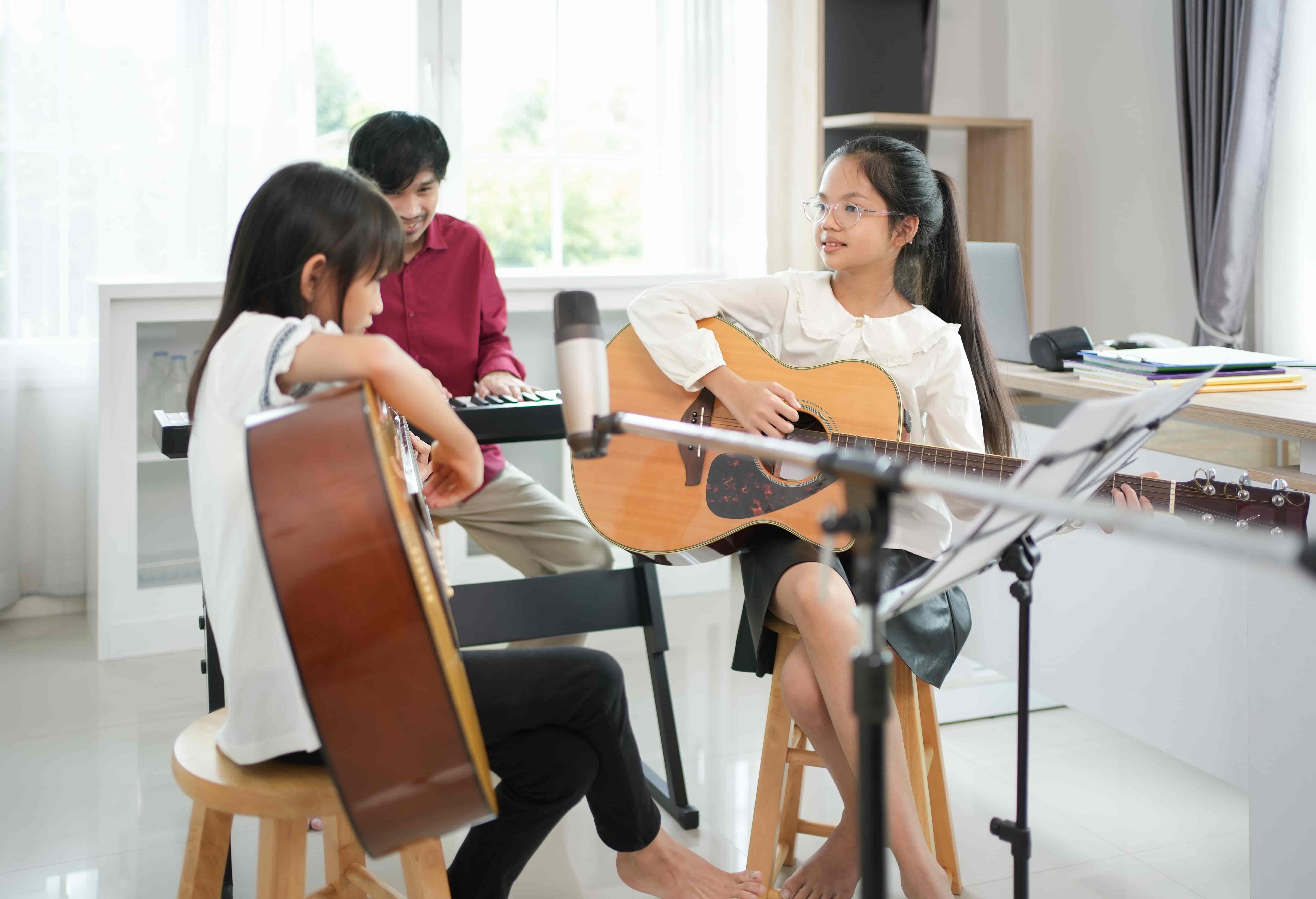
School-Age (Rock Bands): "School of Rock" style programs where kids form a band are trending. They have to negotiate setlists, support each other during solos, and handle the nerves of performance as a team. It is team sports without the concussion risk.
The "Holistic" Music School
How do you find this type of music education that focuses on holistic needs of children? Avoid schools that market purely on "Exam Results" or "Competition Wins." Look for schools that use keywords like ‘Student-led learning’, ‘Collaborative ensembles’, ‘Creative expression’
Ask the director: "How do you handle frustration in lessons? Do you focus on composition and improvisation?" A school that encourages kids to write their own music is prioritizing their voice and self-expression over rote memorization.
The Long-Term ROI of Learning Music Activities
Your child might never play Carnegie Hall. They might quit the trumpet in 10th grade. That is okay. The value wasn't the trumpet. The value was the 5 years they spent learning how to listen, how to recover from a mistake in real-time, and how to contribute to something bigger than themselves. Those are the skills that will get them hired in 2040, long after they have forgotten how to read a treble clef.
Conclusion
Music is the original social network. By prioritizing Social Emotional Learning over technical perfection, we give our children a tool for emotional regulation that will serve them for life. In 2026, the best music class isn't the one that produces the perfect scale; it’s the one that produces a confident, empathetic child.



